
Table of Contents
- What Makes the Best Car Wash for Fleets
- Fleet Car Wash Programs: What They Include
- Fleet Car Wash Pricing: What Drives the Bill
- Fleet Washing Best Practices for Consistent Results
- Fleet Washing for Small Businesses
- Vehicle Types, Capability Limits, and Service Areas
- How to Compare Providers Side by Side
- Frequently Asked Questions
Last Updated: October 19, 2026
What Makes the Best Car Wash for Fleets
The best car wash for fleets delivers the same clean, every vehicle, every visit, without pulling drivers off the road for an hour.
At Heroes Car Wash, we run an express tunnel operation, so we think about fleet throughput constantly.
Below are the seven factors that separate a fleet-grade wash from a consumer one, plus how to compare providers before you sign.
The Seven Factors That Decide It
Judge any provider on these seven criteria, in this order:
- Consistency – Does every vehicle come out the same, or does quality drift?
- Cycle time – How long is each vehicle out of service?
- Capacity – Can the site handle your whole fleet in one window?
- Coverage – Does the wash reach undercarriage, wheel wells, and rear doors?
- Pricing structure – Per-wash, subscription, or account billing?
- Service area and access – Is the site on a route your drivers already run?
- Environmental compliance – Where does the wastewater go?
Most buyers weigh price first. That is backwards: a cheap wash that misses road film costs you in repeat visits, and appearance is part of asset protection.
Rank consistency and cycle time above price. A fleet wash that is fast and repeatable protects resale value and keeps drivers productive. A cheap wash that requires a second pass is neither.
Fleet Car Wash Programs: What They Include
Fleet car wash programs are structured service agreements that give commercial clients predictable pricing, priority access, and consistent results across every vehicle. They differ from consumer washes in billing, scheduling, and reporting.
A typical program includes a recurring schedule, a dedicated account contact, consolidated invoicing, and per-vehicle usage tracking. The best also recommend wash frequency based on how hard your vehicles work.
Express Tunnel and On-Site Options
Two delivery models dominate: express tunnel and on-site mobile washing.
Express tunnel runs vehicles through a fixed line with presoak, high-pressure wash, soap, rinse, and dry cycles.
On-site washing brings mobile units to your lot. It eliminates drive time but runs slower per vehicle and depends on water access and drainage at your site.
For most commercial fleets on regular routes, tunnel throughput wins on downtime. On-site wins when vehicles cannot leave the yard.
Fleet Car Wash Pricing: What Drives the Bill
Fleet car wash pricing depends on volume, vehicle type, wash package, and billing structure. Providers rarely publish fleet rates, so expect to request a quote, but a quote you cannot benchmark is a quote you cannot negotiate. Here is how to estimate cost before you call.
The Four Variables That Move the Number
- Volume, Per-vehicle cost drops as fleet size grows. Ask for the rate at your exact count, not a generic “starting at” figure.
- Vehicle type, A box truck takes more time, chemistry, and sometimes a second pass than a sedan. Confirm the rate for your actual mix; a quote built on sedans will not survive a fleet of tall vans.
- Package level, Exterior-only is the floor; undercarriage, wheel treatment, or spot-free rinse raise the rate. Standardize one package across the fleet so billing and results stay consistent.
A Practical Way to Estimate Your Bill
You will not get a firm rate without a quote, but you can build a working estimate: multiply vehicle count by washes per month, then by the quoted per-vehicle rate for your package and mix.
Run the same math for each bidder. If one quote is far below the others, find out why before you sign, a low rate often means a shorter cycle, a thinner package, or fees that appear later.
The most common billing mistake is signing a per-wash agreement without confirming how unused washes are handled. Ask directly whether credits roll over, expire, or are forfeited. Get the answer in writing before you sign.
Billing and Account Setup
Most fleet accounts run on one of three structures, each with a trade-off.
- Prepaid credits, You pay upfront for a block of washes. Simple, but unused credits may expire, and a slow month ties up cash.
- Monthly subscription, A fixed fee for a set number of washes or unlimited service. Predictable for budgeting, but confirm what “unlimited” actually covers and whether a fair-use cap applies.
- Consolidated invoicing, You are billed per period for washes used. Best visibility per vehicle, but you need a reliable wash log so the invoice matches reality.
Ask for a sample invoice before committing, you want per-vehicle visibility to spot abuse or skipped vehicles. Confirm how the provider handles a vehicle out of service for a week, and whether you are billed anyway.
Fees and Terms to Read Before You Sign
Beyond the per-vehicle rate, scan the agreement for these line items:
- Setup or onboarding fee, Some providers charge to open a fleet account.
- Minimum monthly spend, A floor that can price out a small fleet in a slow month.
- Overage rate, The per-wash price if you exceed your plan.
A provider that quotes a flat rate without asking about fleet size, vehicle mix, and frequency has not done the work. The provider that asks the right questions up front is the one whose number will hold.
Fleet Washing Best Practices for Consistent Results
Consistent fleet washing comes down to three things: a fixed schedule, a standard package on every vehicle, and a simple way to verify each wash happened. Remove any one and quality drifts.
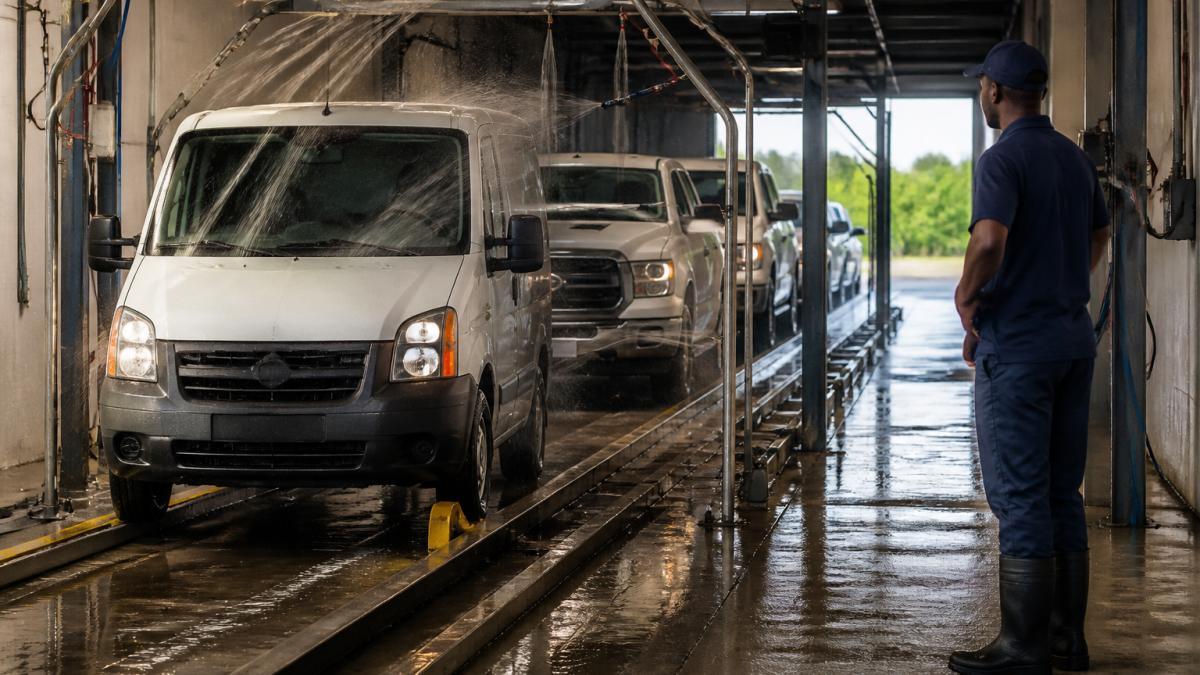
Here is how we would set up a fleet account for repeatable results:
- Set a fixed wash day per vehicle group so nothing gets skipped during a busy week.
- Standardize the package across the fleet. Mixed packages create mixed results and confuse billing.
- Log every wash by vehicle number, not driver name, so you can audit usage.
A common mistake is letting drivers choose their own wash times. It feels flexible but destroys your ability to forecast volume and negotiate pricing.
Fleet Washing for Small Businesses
Small fleets, roughly three to fifteen vehicles, get the worst of both worlds: too small for enterprise contracts, too big for consumer pricing.
Start with a provider that already runs fleet accounts and ask to join at your volume tier.
For a small business, the practical checklist looks like this:
- Confirm the provider serves your fleet size without a minimum that prices you out
- Get the per-vehicle rate for your actual vehicle mix, not a generic figure
- Confirm whether a subscription covers unlimited washes or a fixed count
A dealership or a service business with branded vehicles has an extra reason to care: fleet presentation is marketing. Streaked vans undercut the message on the door.
Vehicle Types, Capability Limits, and Service Areas
Not every wash handles every vehicle. Before you compare providers, confirm the site can physically process your largest unit and that its location sits on a route your drivers already run. A five-minute check prevents a damaged vehicle and a wasted trip.
Vehicle-Type Coverage: What Usually Fits and What Often Does Not
Express tunnels generally handle passenger cars, pickups, SUVs, and most cargo vans. The trouble starts at the edges of the fleet:
- Lifted trucks and modified pickups, A lift kit raises overall height and can change track width. A vehicle that cleared the tunnel last year may not clear it after a suspension change.
- Dual-rear-wheel vehicles, Wider rear track can exceed the guide rail spacing on some tunnels.
- Box trucks and cube vans, Height is the usual blocker. Many tunnels have a clearance well below what a loaded box truck needs.
Ask for the height and width limits in writing, and measure your tallest and widest units against them. Do not rely on a verbal “you’ll be fine.”
Ask the provider for their maximum vehicle height and width before your first visit. If your tallest unit clears the limit by only a few inches, confirm whether mirrors must be folded. This one question prevents a damaged vehicle and a wasted trip.
Access and Site Logistics
Clearance is only half the check. Confirm the site can handle your vehicles on the ground:
- Entrance and exit turning radius, A long wheelbase vehicle needs room to line up. Ask whether the approach lane fits your largest unit.
- Queue space, A tunnel with a short queue lane backs your trucks onto the street at peak hours.
- Hours vs. your shift, A site that opens after your drivers leave the yard is useless. Match the wash window to when your vehicles are actually available.
Service Area and Route Economics
Service area matters as much as capability. A wash that requires a forty-minute detour adds operational downtime to every visit, the cost that never shows up on the invoice.
Do the math on drive time, not distance. A site ten minutes away at midday can be thirty minutes away at shift start.
A site on a route your drivers already run costs almost nothing in downtime; a dedicated trip costs a driver-hour every visit.
Matching Vehicle Type to Delivery Model
Use this rule of thumb when you compare providers:
- Cars, pickups, SUVs, cargo vans on regular routes, Express tunnel, for throughput and consistency.
- Box trucks and taller commercial units, Confirm tunnel clearance first; if they do not fit, look for a provider with a dedicated commercial or heavy-vehicle lane.
- Buses, trailers, heavy equipment, On-site or dedicated heavy-vehicle washing, with a written scope for what gets cleaned.
How to Compare Providers Side by Side
Comparing fleet wash providers comes down to scoring them on the same criteria with the same weights.
Use this framework. Score each provider from 1 to 5 on every row, then multiply by the weight.
| Criterion | Weight | What to Verify | Score (1-5) |
|---|---|---|---|
| Consistency | 25% | Same package every visit, documented process | |
| Cycle time | 20% | Minutes per vehicle, measured on site | |
| Capacity | 15% | Vehicles per hour during your window | |
| Vehicle coverage | 15% | Height, width, and type limits in writing | |
| Pricing clarity | 10% | Per-vehicle rate, rollover terms, fees | |
| Service area | 10% | Drive time from your yard at shift start | |
| Environmental practice | 5% | Wastewater handling and permits |
Two rows deserve extra scrutiny. Commercial wash water carries soap, oil, and road grime, and many jurisdictions restrict what can enter storm drains; the EPA’s stormwater program guidance explains why wash water is regulated differently from rainwater.
On reviews, check more than the star rating. The FTC’s guidance on online reviews is a useful reminder that ratings can be gamed, so weigh them alongside what you see on site.
For background on why regular washing protects paint and resale value, the consumer vehicle care guidance from the FTC covers the basics of avoiding damage during cleaning.
Fleet washing only works when it is repeatable, fast, and easy to bill.
At Heroes Car Wash, our express tunnel format is built for high-throughput exterior cleaning with a consistent process on every vehicle.
Frequently Asked Questions
How much does fleet car washing cost?
Fleet car wash pricing depends on fleet size, vehicle type, wash frequency, and whether you choose an express tunnel or on-site service. Most programs price per wash with volume discounts, or sell flat monthly plans per vehicle. Larger trucks and heavy equipment usually cost more than sedans because they need more time and water. Ask providers for a written estimate based on your actual vehicle count and schedule, and confirm whether undercarriage cleaning and tire dressing are included or billed separately.
How often should company vehicles be washed?
Most fleets do well with a wash every two weeks, with weekly service for vehicles that carry client-facing branding or drive in winter road salt. Fleet washing best practices call for more frequent cleaning when vehicles see heavy road film, corrosive salts, or construction dust. A consistent schedule protects paint and decals, keeps drivers proud of the vehicle, and makes condition checks easier. Set the interval by how fast vehicles get dirty, not by how convenient the calendar looks.
Are unlimited car wash plans worth it for fleets?
Unlimited plans can save money when a vehicle washes more than about three times a month, which is common for sales, delivery, and service fleets. The math works best for high-mileage vehicles in a compact service area. Before signing, confirm there are no blackout dates, check how many vehicles one plan covers, and ask whether plans transfer between drivers. For low-mileage fleets, pay-per-wash pricing with a fleet account often costs less overall.
What is the difference between an express car wash and a mobile fleet wash?
An express car wash runs vehicles through a fixed tunnel, usually finishing in a few minutes, and works well for cars, vans, and light trucks that can drive to the site. A mobile fleet wash brings water and equipment to your lot, which suits heavy equipment, box trucks, and vehicles that cannot leave the yard. Express tunnels deliver consistent output and lower per-wash cost at volume. Mobile service trades speed and price for convenience and coverage of oversized vehicles.